
 By
There is no fixed graft number for any stage of hair loss. Your number depends on the size of the thinning area, your donor hair, your hair type and the look you want. Only an in-person assessment with a surgeon can turn those into a reliable figure.
This guide explains what a graft is, how each stage of hair loss shapes the plan, and where your hairstyle fits in.
What is a graft, exactly?
A graft is a follicular unit: a tiny natural cluster of about two to four hairs that grow from the scalp together. Surgeons move these clusters whole, because that is how hair grows naturally.
So a graft count is not a hair count. A plan measured in grafts moves several times as many hairs, depending on the units in your donor area.
Grafts are taken from the back and sides of the head, where hair is usually least affected by thinning. With DHI (Direct Hair Implantation), each one is removed with a fine punch and set straight into the thinning area with an implanter pen.
How does your hair loss stage shape the plan?
Surgeons grade men’s hair loss on the Norwood scale and women’s on the Ludwig scale, which has three grades. Your stage shows where hair is missing and how large the area is. On its own, it does not give a graft number.
- Early stages. Thinning is often limited to the temples or the front edge of the hairline. The area is small, so the plan is usually modest.
- Middle stages. The hairline has moved back, and the top may be thinning too. More scalp needs covering, so the plan grows.
- Advanced stages. The top and crown may be largely bare. Donor supply often sets the limit here, and the surgeon decides where grafts will make the most visible difference.
- Women on the Ludwig scale. Thinning tends to spread across the top, while the hairline often stays in place. Grafts go between existing hairs to build density.
Two people at the same stage can still need very different plans. That is why careful surgeons do not quote numbers by stage alone.
What else decides your graft number?
Beyond the size of the area, four things make a big difference.
- Donor density. This is how closely the follicular units grow at the back and sides. A dense donor area gives the surgeon more to work with, but it is a limited supply that has to last a lifetime.
- Hair thickness and curl. Thick, coarse or curly hair covers more scalp per graft than fine, straight hair. The contrast between your hair and skin colour also affects how full the result looks.
- The look you want. A dense, sharp hairline needs more grafts than a softer one. A slightly irregular edge often looks more natural anyway.
- Future thinning. Transplanted follicles normally keep growing for life, but the original hair around them can still thin with age. A sound plan keeps donor hair in reserve and sets a hairline that will still suit you later.
Does your hairstyle change the number?
Often, yes. The way you wear your hair decides which areas are on show. Tell the surgeon exactly how you style it now, and how you would like to.
- Swept-back and slicked styles put the hairline on full display, so density at the front matters most.
- Short crops and skin fades can let the scalp show through on top, especially under bright light.
- Longer, textured cuts add cover through length and movement, which can make lower density look fuller.
- Side partings create a clear line through the hair, which the plan may need to fill along its length.
Grooming can work with the plan, too. A little more length on top or a matte, textured finish can make the same number of grafts look fuller.
Why can’t anyone tell you your number online?
Online calculators and quick quotes can only guess. They cannot see your donor area, feel your hair or judge how your thinning might progress.
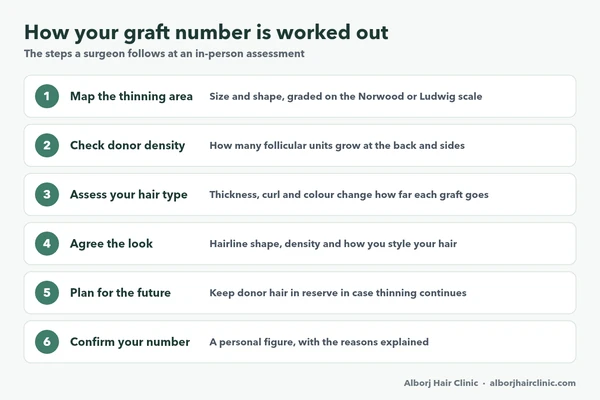
At an in-person assessment, the surgeon examines the donor area, checks the pattern and quality of your hair, and asks what you want. You should leave knowing your number and the reasons behind it.
“No two scalps are the same, so I don’t give a graft number without seeing the patient. I need to examine the donor area and the hair itself, and understand what the person wants, before I can plan honestly.”
If thinning is sudden or patchy, a doctor may want to find the cause first and may suggest other options before surgery.
How many grafts does a beard need?
Beards follow the same logic: the number depends on the area to fill and the density you want. At Alborj Hair Clinic, most beard transplant clients need 2,000 to 2,500 grafts, depending on coverage.
Filling a few patches on the cheeks is a smaller job than building a full beard from sparse growth. Growth usually starts within about three months, with full density at nine to 12 months.
Trimming can usually start after four weeks and full shaving after six, though your surgeon will confirm the timing for you.
About Alborj Hair Clinic
Alborj Hair Clinic is a hair transplant clinic in Mazaya Centre, Al Wasl, Dubai. Its surgeon, Dr Dimitrios Ziakas, has 24 years of experience and has performed more than 4,000 hair transplant procedures. He is a member of the International Society of Hair Restoration Surgery (ISHRS) and uses the DHI (Direct Hair Implantation) technique.
Anyone who wants a personal graft plan can book an assessment at this hair transplant clinic in Dubai.
Its website includes before-and-after case studies, which help show how a planned number of grafts looks once grown.
Frequently asked questions
Is a higher graft number always better?
No. The right number fills the area you care about while protecting donor hair for later. Using more than you need can leave less for the future.
Can I have a second procedure later?
Sometimes, if enough donor hair remains. That is one reason surgeons plan for future thinning from the start.
Will all the grafts grow straight away?
No. They often shed within the first few weeks, then new hair usually begins to appear at around three months. Expect the full result at about 12 months.
Does the procedure hurt?
The scalp is numbed with local anaesthesia first. Most people report mild discomfort, with little or no pain.

Comments